
EURUSD
- EUR/USD Price: EUR/USD is trading in positive territory around 1.1190 during Friday’s early European session.
- ECB rate: The European Central Bank decided to maintain its deposit rate at 2.50%, as widely expected, following September’s 25-basis-point increase. The Governing Council warned that rising energy prices pose upside risks to inflation and downside risks to economic growth, while noting that underlying inflation and wage developments remain broadly stable.
- ECB's Lagarde: ECB President Christine Lagarde announced that she will step down on 7 February 2027, ending her term ahead of schedule. The two leading government-backed candidates to replace her are former Dutch central bank governor Klaas Knot, viewed as a pragmatic hawk, and Spain’s Pablo Hernández de Cos, considered a moderate dove.
- Q3 GDP: Investors are awaiting the preliminary third-quarter GDP estimate, with expectations for aggregate Eurozone growth now standing at 0.5% quarter-on-quarter, above market consensus. This upward revision follows Ireland’s stronger-than-expected 5.5% quarterly GDP growth, which has improved expectations for the broader regional economy.
- Eurozone inflation: Markets will also focus on preliminary October inflation figures from the major Eurozone economies, alongside the September unemployment rate. These releases could provide further insight into underlying price pressures and labour-market conditions, potentially influencing expectations for the ECB's future policy decisions.
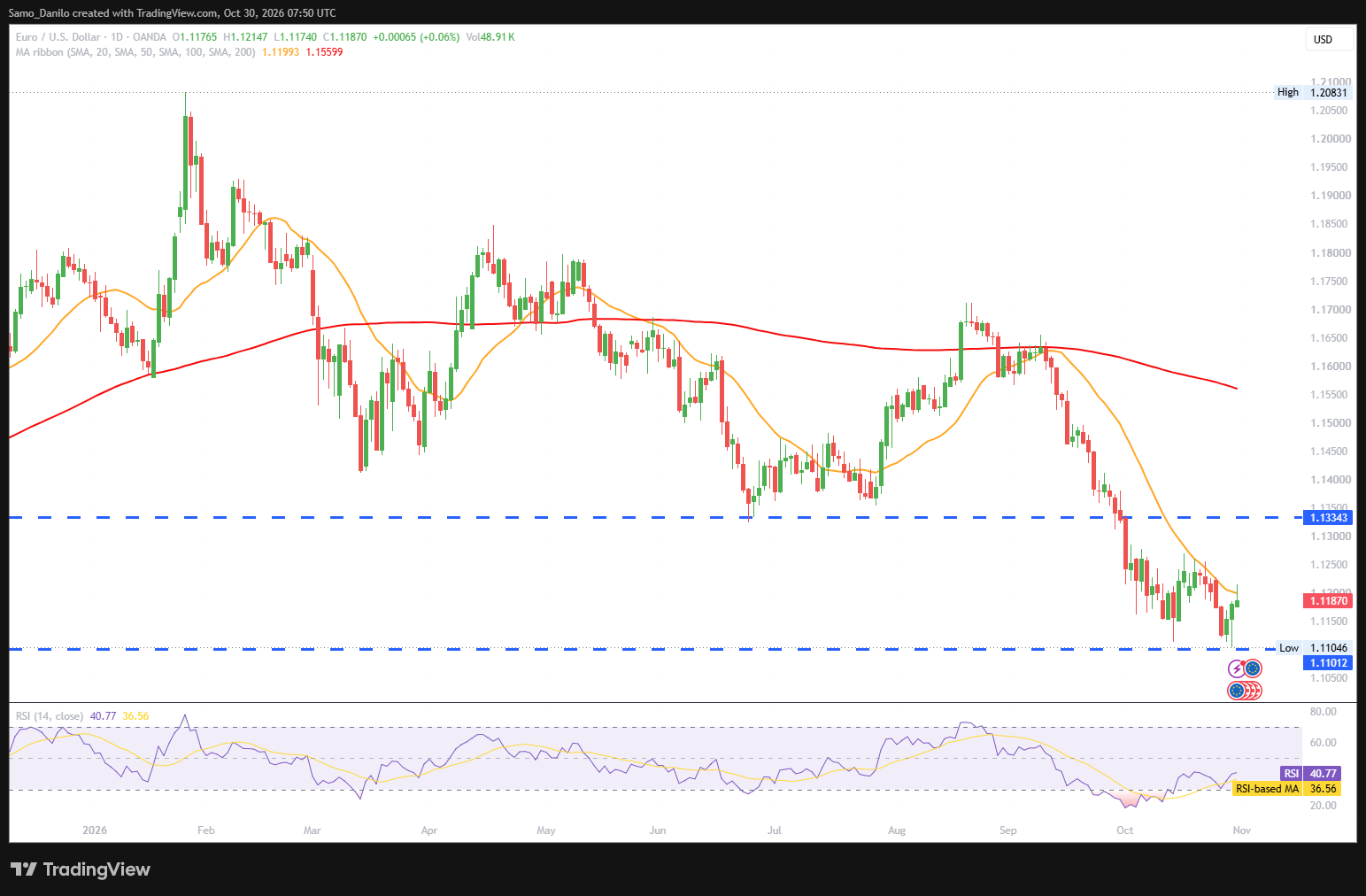
| SMA (20) | Falling |  | |
| RSI (14) | Slightly Falling | |
|
| MACD (12, 26, 9) | Slightly Falling | |
Closing statement: EUR/USD is showing positive momentum around 1.1190, supported by the ECB's relatively stable assessment of underlying inflation and expectations of stronger Eurozone GDP growth. However, rising energy prices remain an inflationary risk, while upcoming GDP, inflation and employment figures could determine the pair's next move. Stronger-than-expected economic data may provide additional support for the Euro.
GBPUSD
- GBP/USD Price: GBP/USD is trading in positive territory around 1.3400 during Friday’s early European session, extending its recent gains as investors assess the latest UK and US economic developments.
- Defence spending: The UK has set a target to increase defence spending to 3% of GDP, with Finance Minister John Healey also announcing billions in additional aid for Ukraine. The announcement was described as a “clear message to Moscow”, highlighting the government's commitment to strengthening national security and supporting Ukraine.
- Q3 GDP: The US economy expanded at an annualised quarterly rate of 3.4% in the third quarter, matching forecasts but exceeding the market consensus of 3.2%. Consumer spending and investment both outperformed expectations, while inventories and public spending also made positive contributions to overall growth.
- Labour market: Initial jobless claims came in at 194K, below expectations of 198K, while continuing claims declined to 1.70 million from the forecast of 1.72 million. The figures point to continued resilience in the US labour market, potentially supporting the US Dollar.
- Business confidence: The Lloyds Business Barometer for October rose to 47 from 41 in the previous month, indicating an improvement in business confidence across the UK.
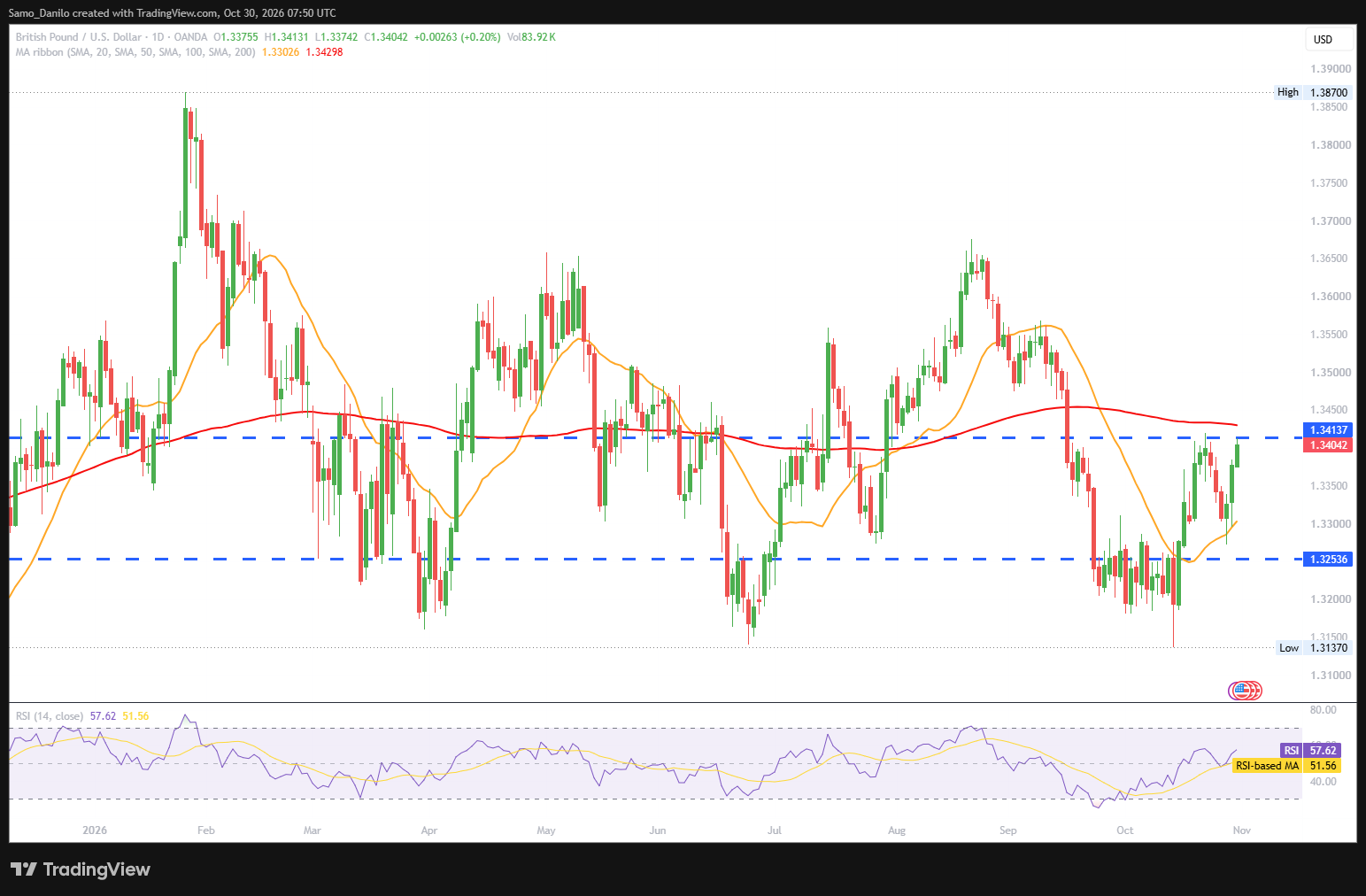
| SMA (20) | Slightly Falling | |
|
| RSI (14) | Rising |  | |
| MACD (12, 26, 9) | Rising | | |
Closing statement: GBP/USD is trading higher around 1.3400, supported by improving UK business confidence and positive market sentiment. However, stronger-than-expected US GDP growth and resilient labour-market data could provide further support for the US Dollar, potentially limiting Sterling's upside. The pair's near-term direction will depend on how markets balance the improving UK outlook against continued US economic strength.
XAUUSD
- XAU/USD Price: Gold prices continued their intraday decline during Friday’s early European session, breaking below the psychologically important $4,000 level.
- PCE inflation: US Personal Consumption Expenditures (PCE) inflation came in line with market expectations, with headline prices rising by 0.5% month-on-month and core inflation increasing by 0.3%.
- Treasury yields: US Treasury yields fell sharply as investors moved into government bonds following disappointing technology-sector earnings.
- US-Iran: US Vice President JD Vance reportedly sent a direct letter to Mohsen Rezaei, secretary of Iran's Supreme National Security Council, in an effort to revive peace negotiations.
- Fed officials: Investors will monitor comments from Fed's Mary Daly and St. Louis Fed President Alberto Musalem later today. Daly, considered one of the more dovish FOMC members, is a non-voter in 2026 but will gain voting rights in 2027, while Musalem is not scheduled to vote until 2028.
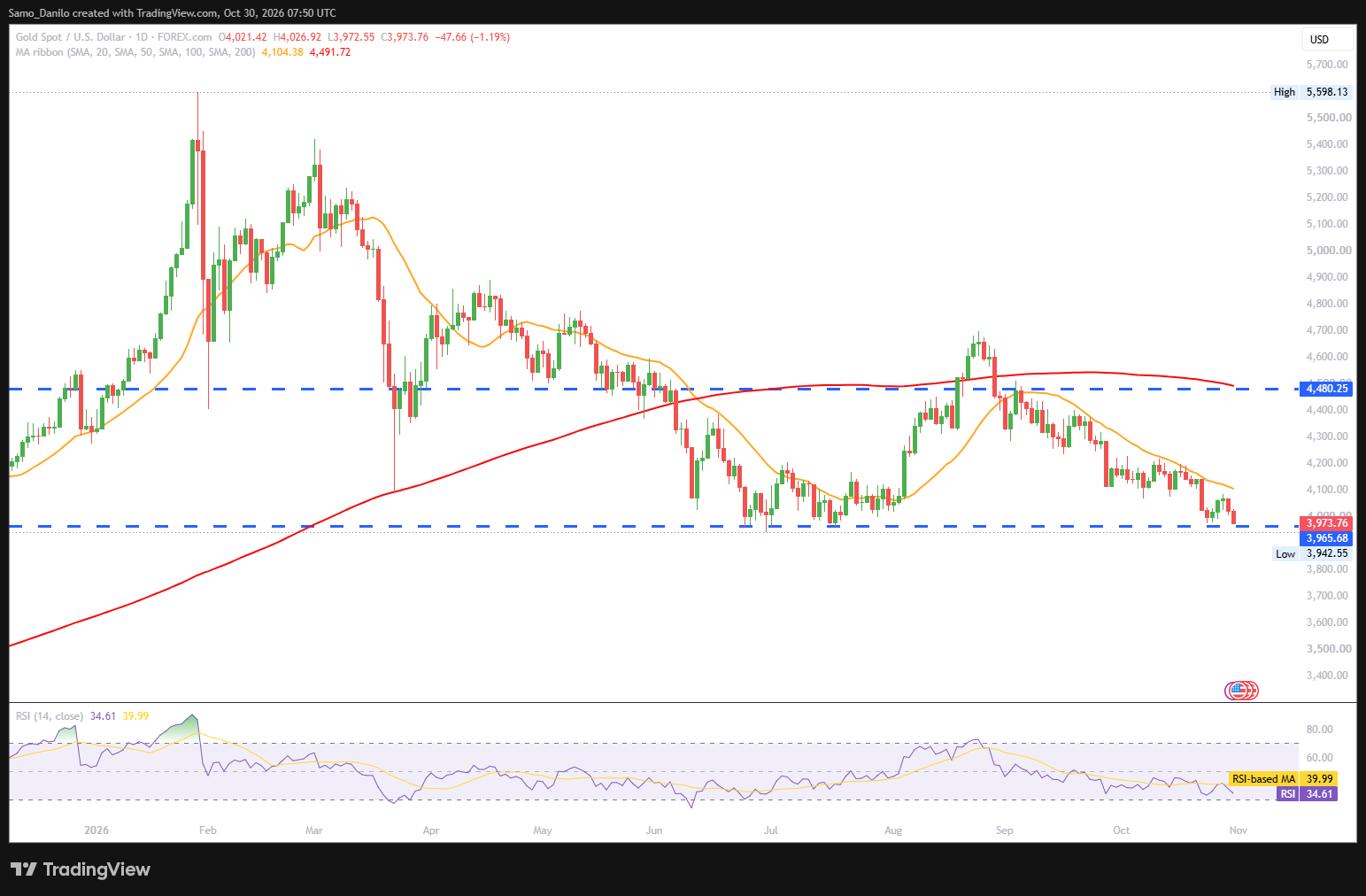
| SMA (20) | Slightly Falling | |
| RSI (14) | Slightly Falling | |
| MACD (12, 26, 9) | Slightly Falling | |
Closing statement: Gold remains under significant selling pressure below $4,000, despite falling US Treasury yields potentially offering some support to the non-yielding metal. In-line PCE inflation and upcoming comments from Fed officials will shape expectations for monetary policy, while developments in US-Iran negotiations could influence safe-haven demand. The immediate technical outlook remains bearish unless buyers manage to reclaim the $4,000 level.
CRUDE OIL
- Crude Oil Price: West Texas Intermediate (WTI), the US crude oil benchmark, is trading around $105.00 during Thursday’s early European session, maintaining elevated levels amid ongoing supply concerns and geopolitical uncertainty.
- Oil refineries: According to The Wall Street Journal, Ukraine has reportedly suspended attacks on Russian oil refineries, with the pause expected to continue until after the US midterm elections and potentially further into November.
- OPEC+ meeting: The seven core OPEC+ members are scheduled to meet on Sunday to decide on December production levels. Although quota adjustments have had a limited impact this year due to supply constraints linked to disruptions in the Strait of Hormuz, investors will closely monitor signals regarding 2027 quotas, the delayed capacity review ahead of the full OPEC+ meeting on 29 November, and developments surrounding Iran.
- Oil reserves: European countries will release 42 million barrels of emergency oil stocks over the next three months, with approximately half consisting of diesel, according to French Economy Minister Roland Lescure.
- Sinopec earnings: China Petroleum & Chemical Corporation (Sinopec) reported a 63.6% year-on-year increase in third-quarter profit attributable to shareholders, reaching approximately $2 billion (13.6 billion yuan).
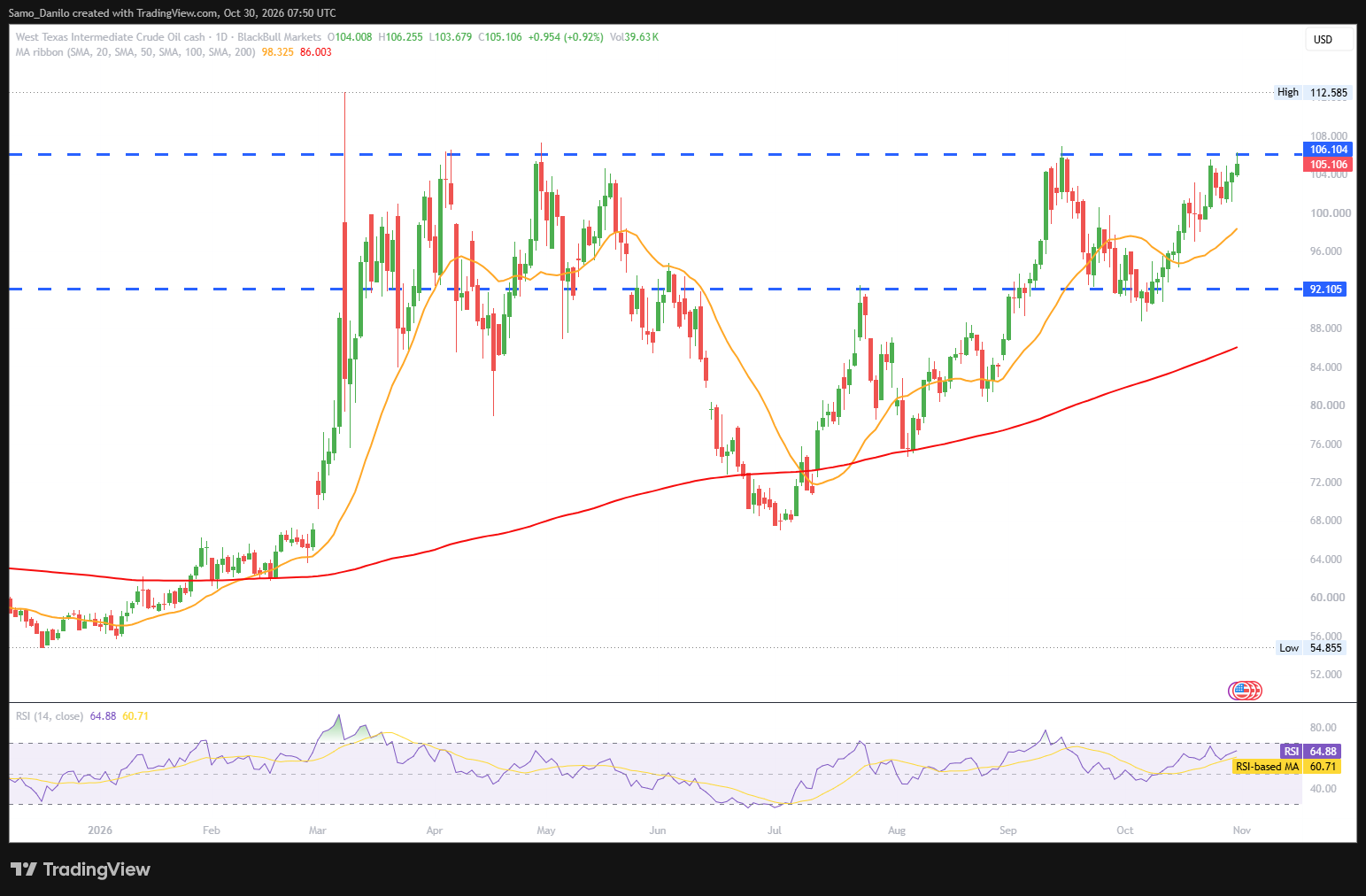
| SMA (20) | Rising | | |
| RSI (14) | Rising | | |
| MACD (12, 26, 9) | Slightly Rising | |
Closing statement: WTI remains elevated around $105.00, supported by persistent supply constraints and geopolitical risks surrounding the Middle East. However, Europe's planned release of emergency reserves and the reported pause in Ukrainian strikes on Russian refineries could ease some supply concerns. The upcoming OPEC+ meeting and developments involving Iran will remain the key factors determining the next directional move in oil prices.
DAX
- DAX 40 Price: The DAX 40 is trading around the 26,000-point mark on Friday morning, reaching its highest level in five weeks.
- Eurozone prices: According to the European Commission's business survey, firms' selling price expectations increased in October. While expectations remain subdued in the services sector, industry and retail are gradually returning towards pre-summer levels.
- Rate expectations: Following the announcement, money markets were pricing in approximately a 67% probability of a rate hike in December, according to LSEG data.
- Economic confidence: The eurozone's economic confidence indicator declined to 96.9 in October, below the expected reading of 97.5. The weaker-than-expected figure points to continued challenges in the region's economic outlook.
- Germany's Merz: German Chancellor Friedrich Merz stated that Germany is willing to work with like-minded partners in Europe and around the world to defend and further develop the rules-based global economic order, during remarks in South Korea.
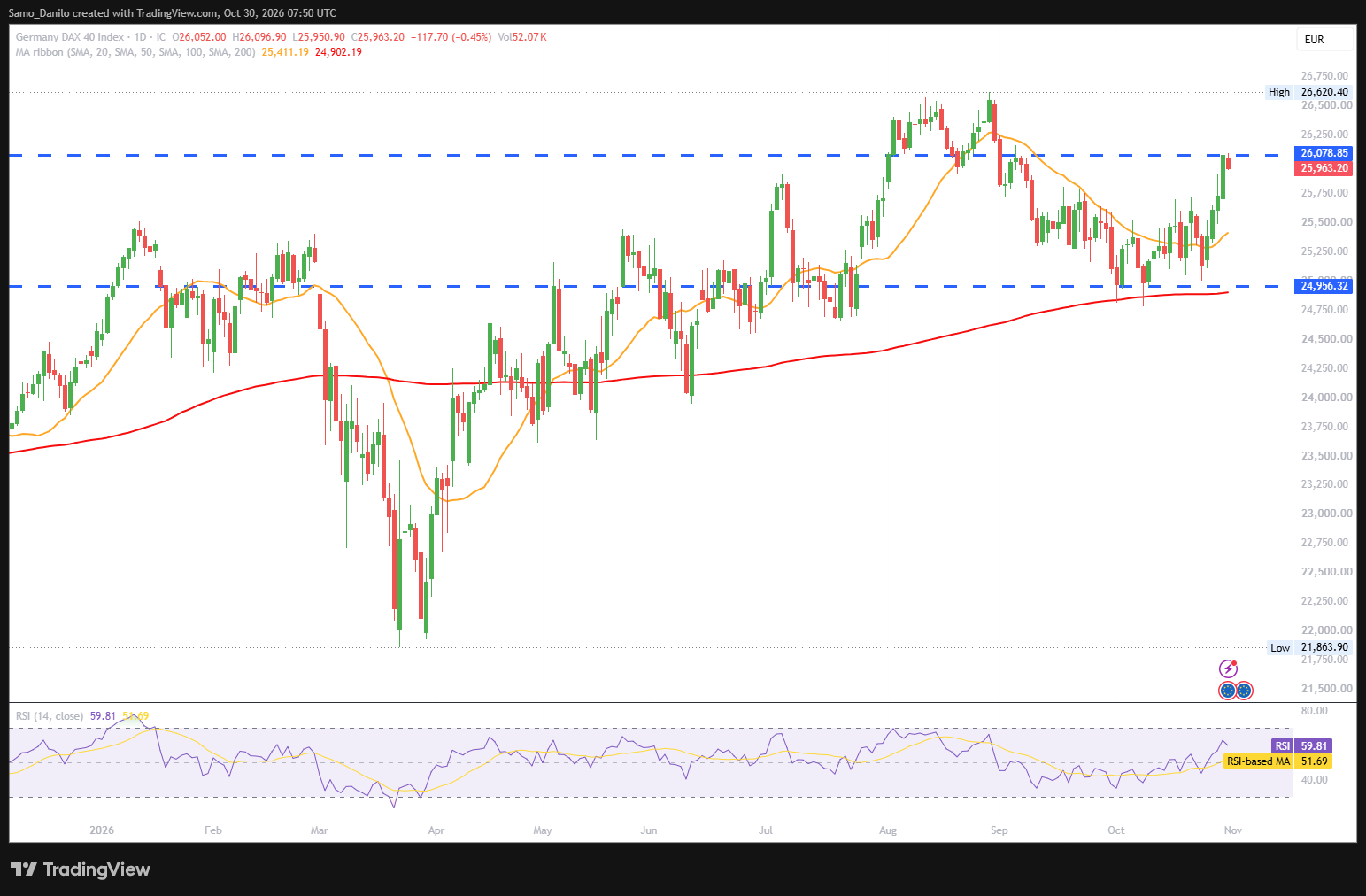
| SMA (20) | Slightly Falling | |
|
| RSI (14) | Rising | | |
| MACD (12, 26, 9) | Slightly Rising | |
Closing statement: The DAX 40 is holding near the 26,000-point level, supported by its recent upward momentum. However, weaker-than-expected eurozone economic confidence and rising expectations of a December rate hike could limit further gains. The near-term outlook will depend on how investors balance the index's positive momentum against tighter monetary policy expectations and regional economic concerns.